
Criminal Court Cases in Harrison County
Harrison County criminal court cases divide by offense level. The 71st Judicial District Court hears adult felonies, and the District Clerk holds those case files. The Harrison County Court at Law handles Class A and Class B misdemeanors through the County Clerk. Fine-only Class C charges may stay with a municipal court or one of the county's justice courts. This map matters because a blank result at one clerk does not mean no case exists.
The working courthouse at 200 West Houston Street in Marshall houses the main felony and misdemeanor record offices. It is not the Historic Courthouse at 1 Peter Whetstone Square. A caller should state the charge level, case number if known, full name, and date range. The clerk can then address the docket, charging paper, judgment, or certified copy instead of a police narrative, which remains with the investigating agency.
Harrison County Felony Case Desk
District Clerk Sherry Griffis is the custodian for adult felony files. The office is in Suite 234 at 200 West Houston Street, Marshall, Texas 75670. The direct phone is 903-935-8409, and the fax is 903-927-1918. This is the practical contact when a Harrison County court case involves an indictment, a felony docket, a district-court judgment, or an older adult felony file.
The official District Clerk page shows the office and its felony-record role.
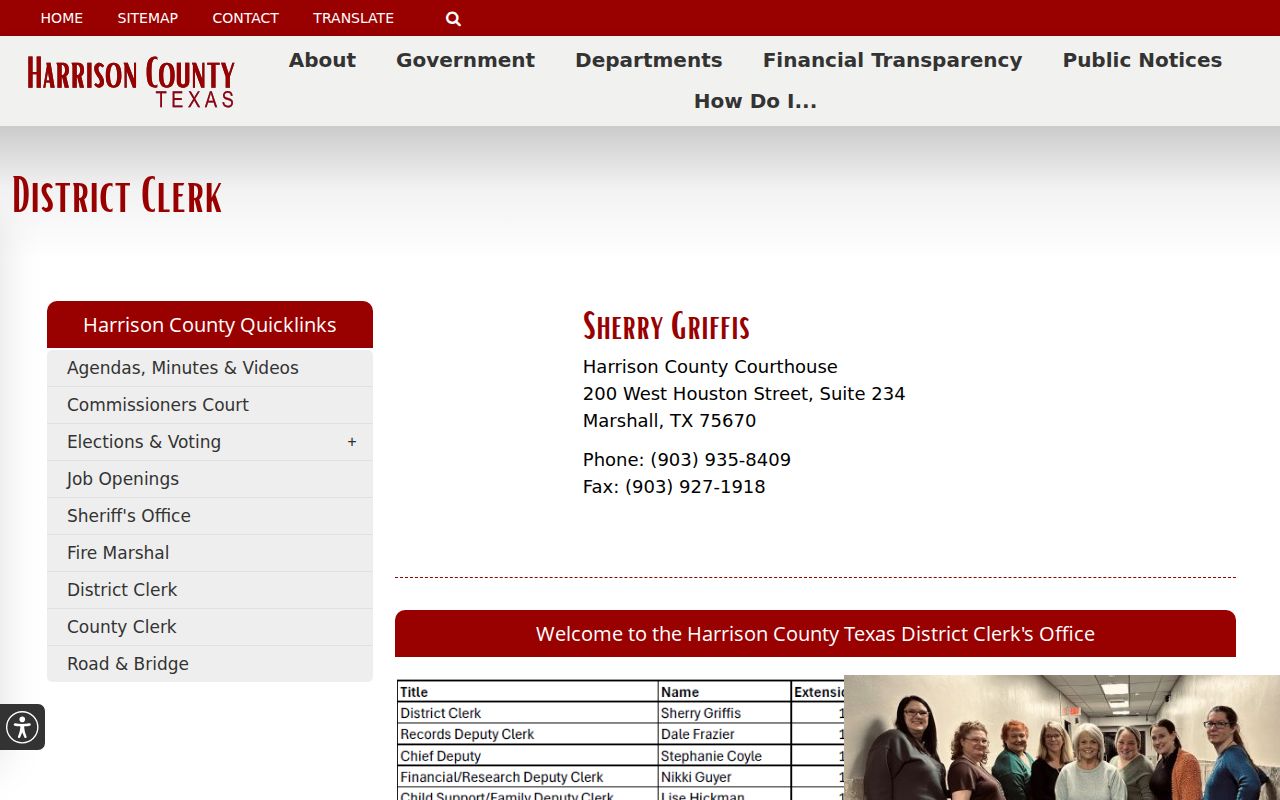
The source view helps a reader confirm the correct Harrison County office before requesting an indictment, docket, judgment, or sentence.
District Clerk
200 W. Houston St., Suite 234
Marshall, TX 75670
903-935-8409
Monday through Friday, 8 a.m. to 5 p.m.
Harrison County Case Record Searches
Start with the most precise identifier available. A case number is stronger than a name, while a filing year and court help separate people with similar names. Harrison County links an official County Clerk self-service endpoint, but its exact controls and criminal coverage were not exposed in the research capture. re:SearchTX is another court channel, not a promise that every local image or older file is online.
- Identify whether the charge is a felony, Class A/B misdemeanor, or fine-only municipal or justice matter.
- Try the official county self-service or court link with a case number first, then a full name and filing year.
- Contact the District Clerk for felonies or the County Clerk for Class A/B misdemeanors.
- Read the docket, then ask for the charging instrument and final judgment rather than relying on event abbreviations.
- For an older file, give the approximate year and ask whether archive retrieval, copy charges, or certification applies.
The re:SearchTX platform can supplement that local search when a participating clerk has supplied the material.
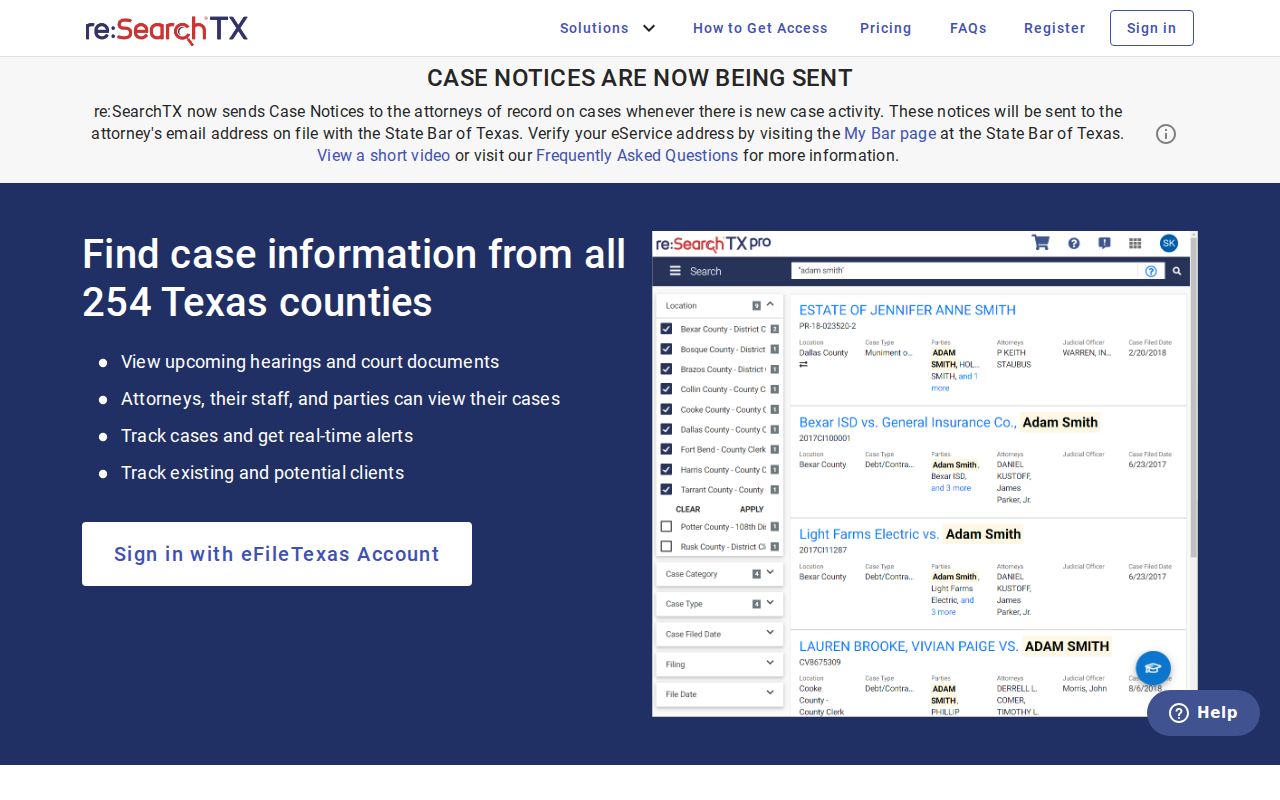
Coverage and document access vary, so the Harrison County clerk remains the source of record when the statewide view is missing or incomplete.
| Search field | Type | Use | Important limit |
|---|---|---|---|
| Case number | Text | Best direct key when known | Use the local format |
| Party name | Text | Find possible cases | Verify identity beyond a name |
| Filed date or year | Date range | Narrow older results | Dates may reflect filing, not arrest |
| Court or case type | Filter | Separate felony, misdemeanor, and civil results | Availability depends on the clerk |
| Document index | Result view | Locate pleadings, orders, and judgment | Images or copies may require a request |
Harrison County Misdemeanor Case Route
Class A and Class B misdemeanor files take a different route. The Harrison County Clerk is the records administrator for the County Court at Law and publishes the direct criminal email CCMisdemeanor@harrisoncountytexas.gov. The office phone is 903-935-8403. A felony request sent there should be redirected to the District Clerk, but starting at the right desk saves time and reduces false “no record” conclusions.
The official County Clerk page identifies this misdemeanor function and contact channel.
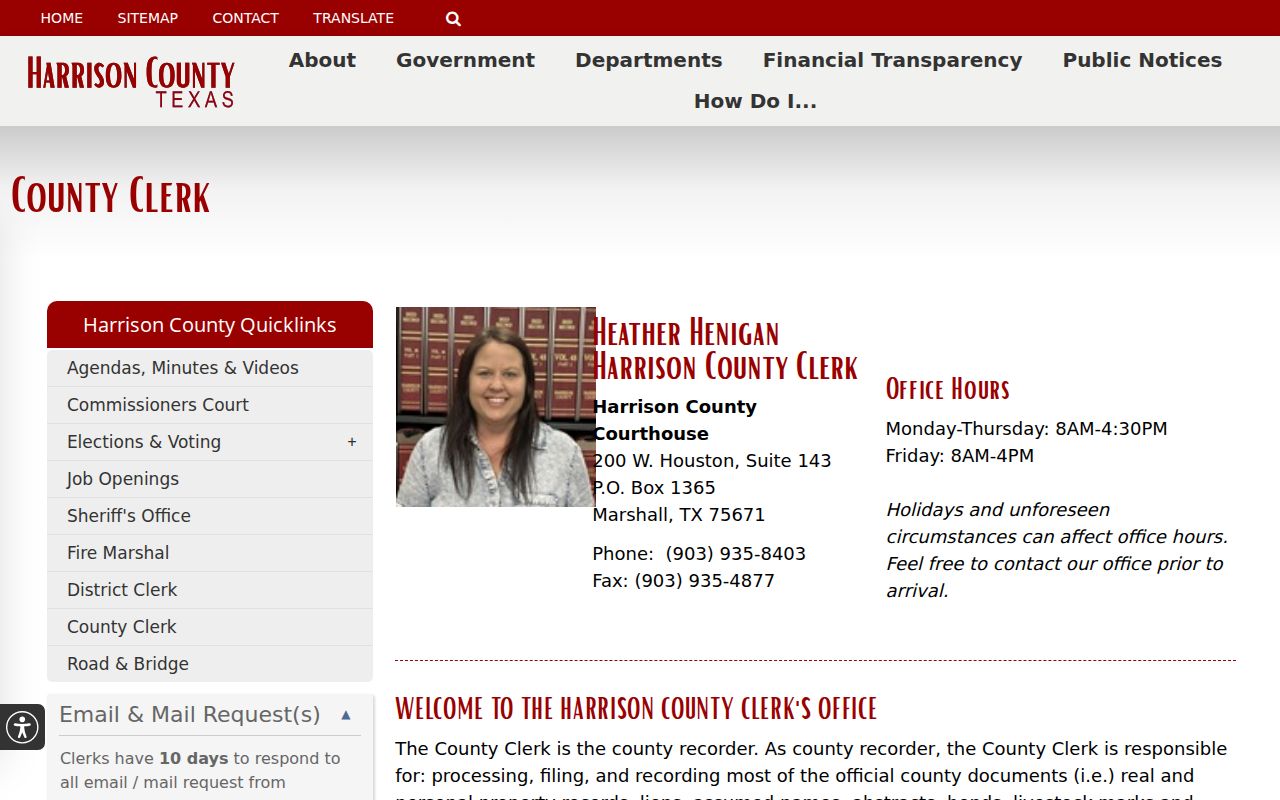
The image supports the local court split that governs where Harrison County case records must be requested.
A city citation is another level again. Marshall and Hallsville municipal courts keep their own fine-only dockets, while justice courts handle precinct matters and magistrate functions. Search the issuing court before assuming that a municipal warrant or citation should appear in a felony index.
What a Criminal Case File Contains
A Harrison County court case file records what prosecutors filed and what the court did. The header establishes the case and venue. The charging instrument states the filed accusation, which can differ from an intake charge. Docket entries track settings, motions, pleas, orders, and the final result. A docket is an index, so obtain the actual judgment when the outcome or sentence matters.
| Case number and court | Identifies the local file, venue, filing date, type, and current status. |
|---|---|
| Charging document | Shows each filed count, offense, statute, grade, and complaint, information, or indictment. |
| Parties and counsel | Names the State of Texas, defendant display, and public counsel or prosecutor entries. |
| Docket events | Lists arraignment, settings, motions, plea, trial, orders, capias, judgment, and sentence events. |
| Bond and financial data | May show bond type or status, fines, costs, restitution, and balances when public. |
| Disposition and sentence | Distinguishes conviction, deferred adjudication, dismissal, acquittal, or no-bill and states court-ordered terms. |
| Restricted fields | Excludes or redacts full birth dates, Social Security numbers, victim and minor identifiers, and sealed content. |
Note: A booking charge is an intake allegation; only the filed case and judgment show what the Harrison County court ultimately handled.
Harrison County Arraignment Dockets
The District Attorney's office links both District Court dockets and County Court at Law jury or arraignment dockets. Those lists can help confirm when a Harrison County criminal case is set, but they do not replace the clerk's full file. The DA is the prosecution office, not the court record custodian and not a defense contact. The county instead publishes qualified appointed-attorney lists for misdemeanor and juvenile matters, with eligibility and assignment controlled by the court.
The official District Attorney page provides those docket routes and office contacts.
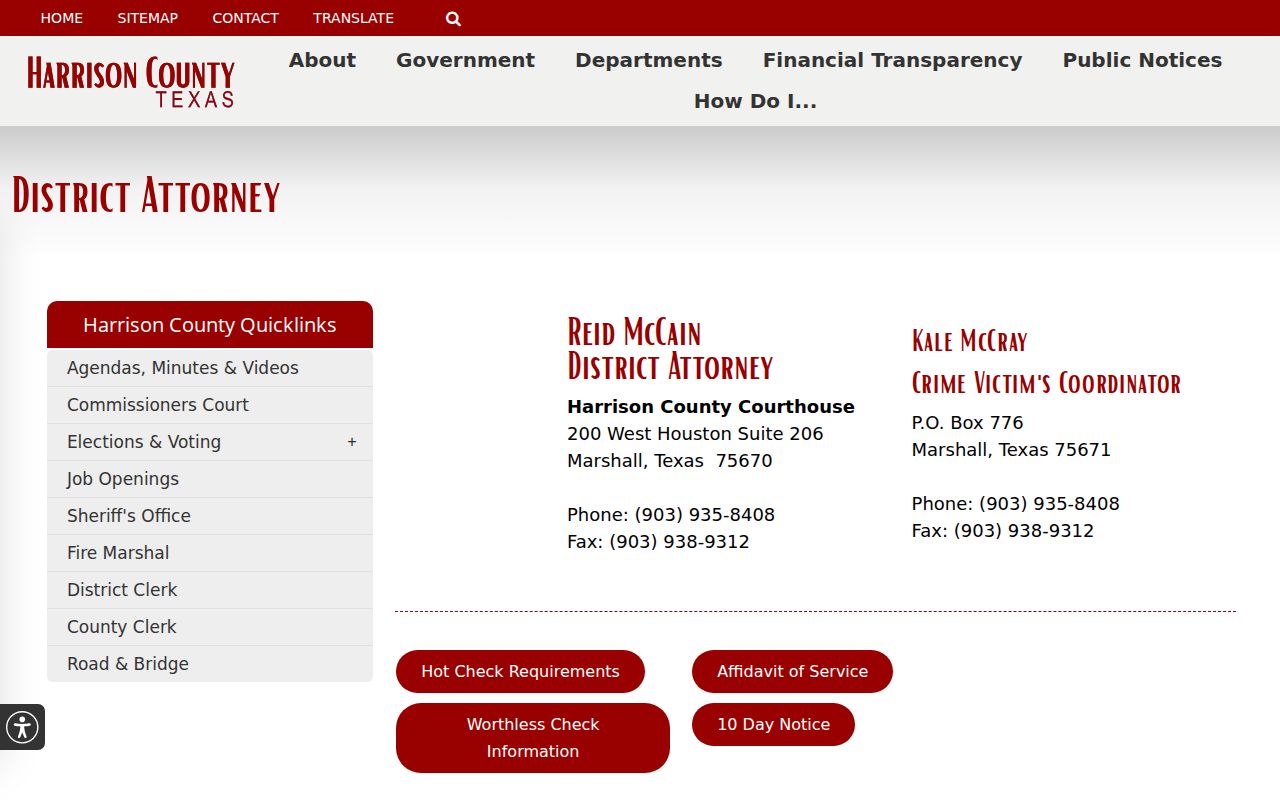
The source view is useful for court-date context, while the District Clerk or County Clerk supplies the controlling documents.
When an online docket uses short event text, ask for the indictment or information, plea papers, judgment, and sentence. “Deferred adjudication” means supervision without an immediate judgment of guilt. A dismissal ends a filed charge without a conviction on that charge. An acquittal is a not-guilty result after adjudication. These outcomes should never be treated as interchangeable.
Criminal Case Stages in Harrison County
A custodial case may begin with arrest and magistration before the prosecutor decides what to file. Texas law calls for the arrested person to be brought before a magistrate without needless delay, generally within 48 hours. A felony can then move to a grand jury, which returns an indictment or declines with a no-bill. Misdemeanors commonly proceed through a prosecutor-filed information.
Case flow: Charges Filed › Arraignment › Pretrial › Plea or Trial › Disposition › Sentencing
Pretrial entries may cover discovery, motions, hearings, and settings. A plea or trial leads to the outcome. After a conviction, the judgment records sentence terms such as confinement, fines, costs, restitution, or community supervision. An appeal or later order may add more entries, so check the latest docket date and read the signed orders.
Older Harrison County Case Files
An older Harrison County criminal case may not be digitized or fully imaged. Give the clerk the full name, approximate filing year, likely offense level, and court. Ask for an archive search, then request the docket sheet, charging instrument, and final judgment. If certification is needed, say so before copies are made. The research did not locate a current Harrison County criminal-copy fee schedule, so confirm cost and delivery method with the correct clerk.
Online public access also follows court rules and technical standards. The Texas Judicial Branch rules and standards page is the official source for the statewide framework.
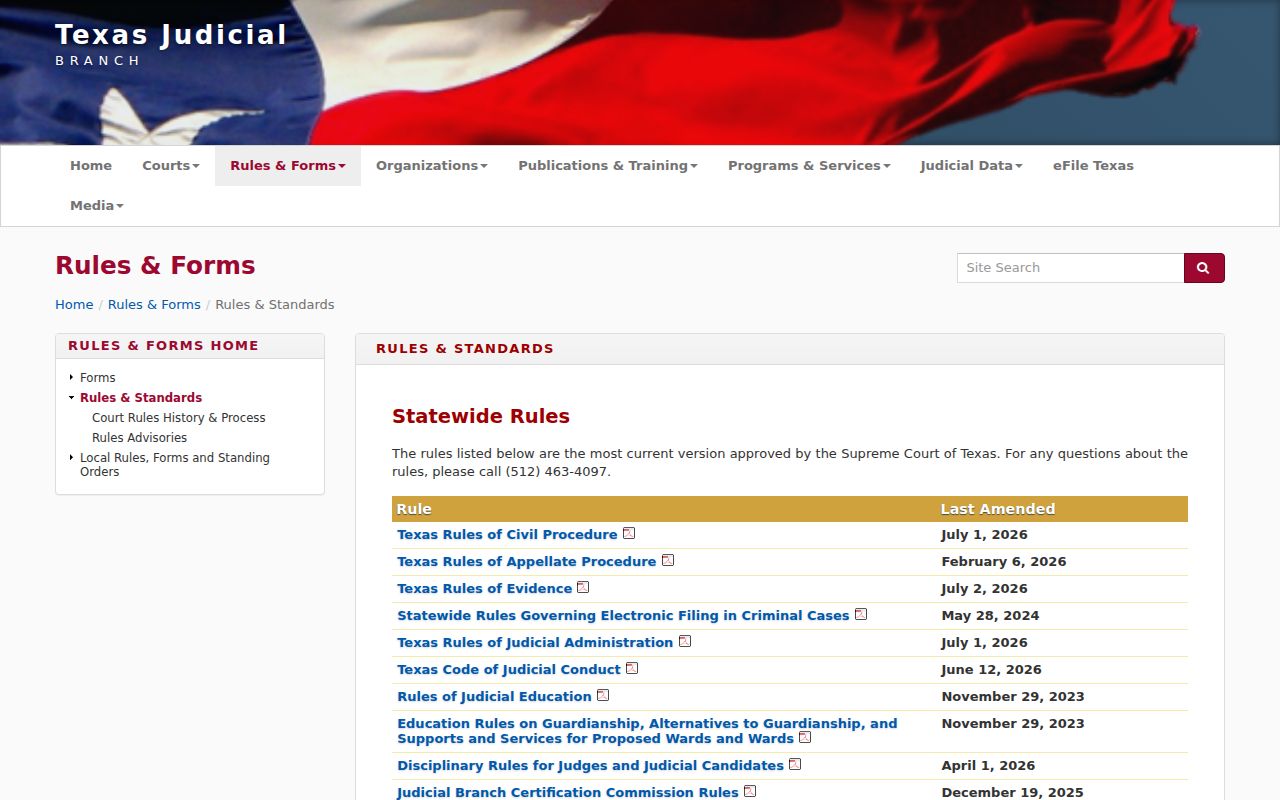
Those statewide rules operate alongside the Harrison County clerk's control of local indexes, paper files, copies, and restricted material.
Access Rules for Case Records
Texas public access does not make every item in a Harrison County criminal case file visible. Court views may redact full birth dates, Social Security numbers, protected identifiers, and victim or minor data. Juvenile records, sealed material, expunged events, and some sensitive documents are restricted. A public index can therefore show less than the paper file, while the clerk may still be barred from releasing protected content.
The Texas Public Information Act governs agency records, while court records also follow judicial rules. Ask the record's actual custodian rather than sending one broad request to every office.
If a Harrison County court case does not appear, confirm spelling, aliases, filing year, and offense level. Then call the District Clerk, County Clerk, municipal court, or justice court that could hold it. re:SearchTX participation varies. The clerk remains the best source for a missing disposition, a certified judgment, or a file that predates online coverage.
Request a Harrison County Judgment
A docket gives the timeline, but a signed judgment supplies the clearest proof of the court's result. Ask the clerk for the final judgment and sentence, plus any later order that altered them. If a docket says “dismissed,” verify which count was dismissed. If it says “deferred,” read the supervision order and later discharge entry. When a name search produces several records, match the court, case number, charge, and date before drawing a conclusion.
For broader context beyond the court file, the Harrison County criminal history overview explains how jail, court, and Texas DPS records connect. The distinction is important: the court file documents prosecution and disposition, while an agency report describes the incident and a booking record documents custody.