
Harrison County Sex Offender Checks
The Texas Public Sex Offender Registry is the main public channel for a Harrison County search. Texas DPS publishes the information that Chapter 62 makes public, and the portal is free. Start with a county or city search when the goal is neighborhood awareness. Use a name search when the person is already known. Running both can reveal an alias, a spelling difference, or an address change that a single query misses.
The Harrison County registry is not the only contact point. A person who lives within Marshall, Hallsville, or Waskom registers with that municipality's local law-enforcement authority. Someone outside municipal boundaries registers with the Harrison County Sheriff. DPS maintains the statewide public layer, while the local authority handles registration, verification, and changes. Call that authority before visiting because Harrison County research found no published county registry-desk schedule, appointment rule, or fee.
Use the record as a safety tool, not a verdict about current conduct. Match the photograph, aliases, age, physical description, address, and offense details before deciding that a result concerns the intended person. A shared name is not enough. If the registry itself is unavailable, DPS lists its Sex Offender Registry Unit at 512-424-2800 for program questions and suspected noncompliance.
Harrison County Registry Reporting Routes
Harrison County boundaries decide who maintains a registration. Inside Marshall, the city police authority receives the registration. The same city-authority rule applies within Hallsville and Waskom. Outside an incorporated place, the Harrison County Sheriff is the local registration authority. The official county directory and county officeholder list provide local source checks when contact details or office leadership change. Texas law generally requires initial registration no later than the later of the seventh day after arrival or the first date allowed by the local authority's policy. The local office also handles required updates and forwards information to DPS. This split matters because a caller may reach the wrong office even though the statewide profile is visible through one DPS system.
The DPS program page provides useful Harrison County context for those local duties.
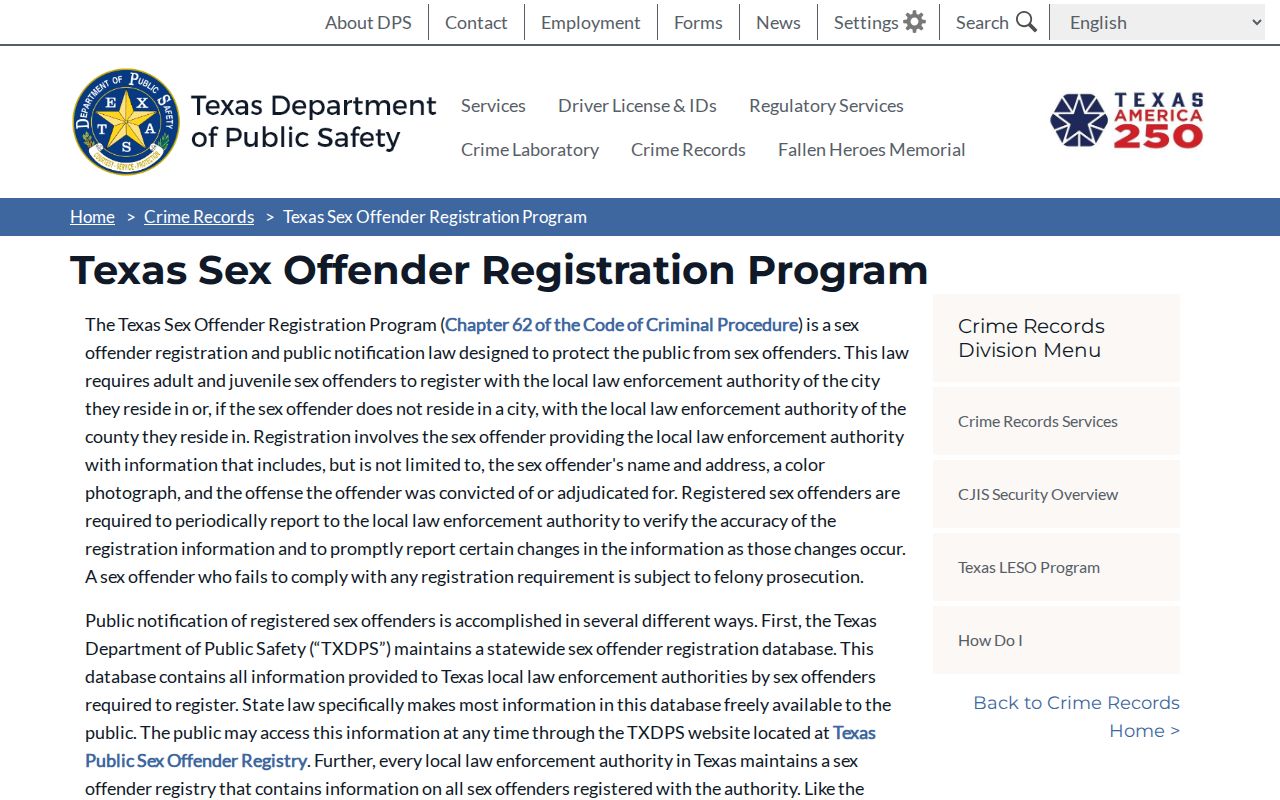
Its statewide explanation helps a Harrison County reader distinguish the local reporting office from the public search system.
Note: Confirm the correct registration office before appearing because a Marshall address and a rural Harrison County address follow different local routes.
Texas Public Sex Offender Registry Searches
DPS offers name and location modes. The Harrison County filter is best for a broad county view, while a city, ZIP, street, map, or radius query narrows the Harrison County area. Search controls can change, so verify the radius choices shown on the live form. The portal also offers an optional notification signup. Alerts can help with later changes, but they do not replace a fresh search when a timely answer matters.
- Open the official DPS registry and review its conditions of use before searching.
- Choose a name search or enter Harrison County, Marshall, Hallsville, Waskom, a ZIP code, or an address-based map query.
- Compare the result list by photograph, aliases, age, physical details, and registered location. Do not rely on the name alone.
- Open the full public profile and read the offense, registration status, verification, and risk information in context.
| Field Label | Type | Required | Notes |
|---|---|---|---|
| Name search | Tab and text form | One search mode | First and last name; aliases may change matches |
| Address or map | Location form and map | For place search | Street, city, and ZIP can shape results |
| City | Text | For city search | Use Marshall, Hallsville, or Waskom |
| County | Dropdown or text | For county search | Select Harrison |
| ZIP | Text | For ZIP search | Use a five-digit ZIP code |
| Radius | Dropdown | No | Verify the current choices on the live form |
| Notifications | Account or email | No | Optional signup for DPS notices |
The Harrison County and city controls can be used in sequence. Broad geography finds nearby entries, while profile details provide the identity check.
Harrison County Registry Alias Searches
An empty Harrison County name result does not settle the question. A profile may use a legal name, known alias, different spacing, or a changed address. Switch to a Harrison County geography search, then narrow by city, ZIP, and map. Review photos and physical descriptors rather than selecting the closest name. This simple change of search mode is especially useful for Harrison County community awareness when the searcher knows a place but not the exact spelling.
For a cross-state Harrison County question, use the National Sex Offender Public Website. NSOPW searches participating jurisdictions and routes readers back to their official records. It adds geographic breadth, but Texas DPS remains the authoritative state source for a Texas entry. A national search should supplement, not replace, a direct Harrison County query.
The Department of Justice search interface illustrates that broader layer.
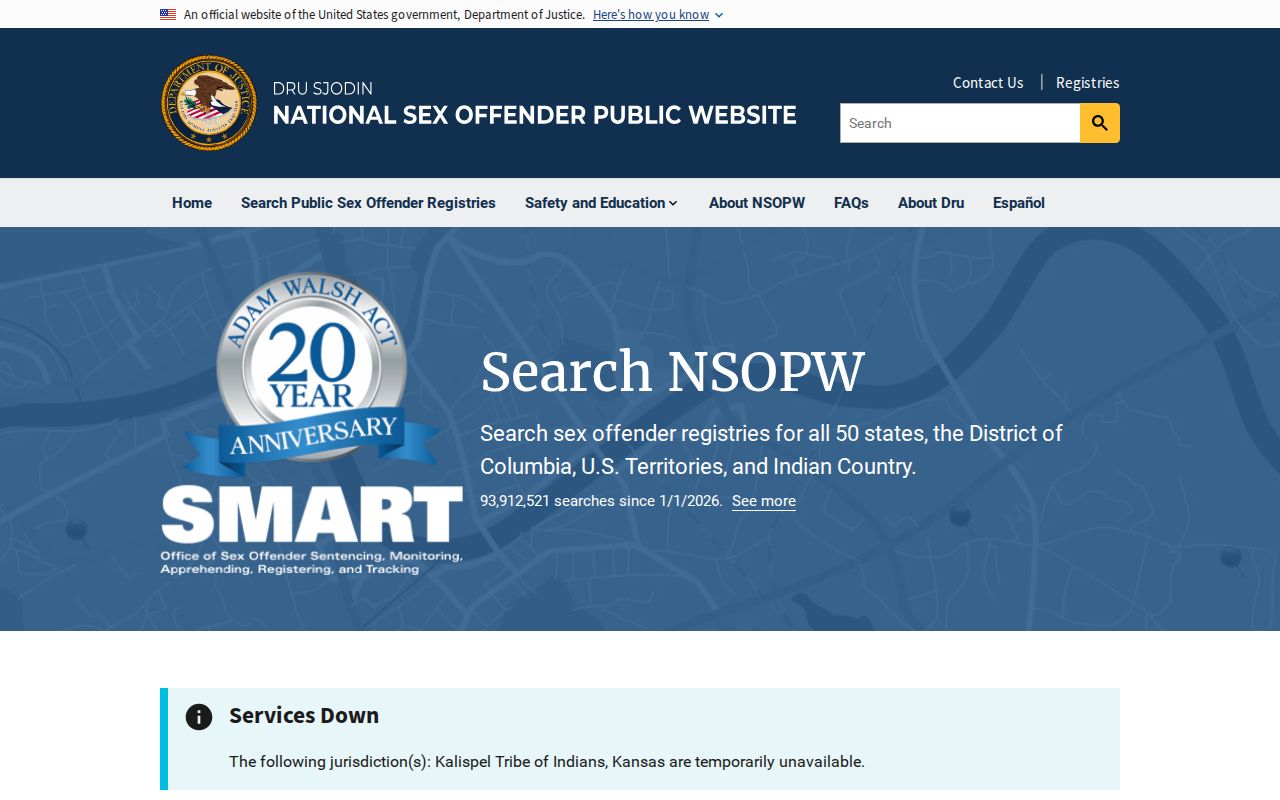
That national view is most useful when a person may have moved across a state line.
Registry Profiles: What They Show
A Texas public profile for Harrison County combines identity cues with registration facts. It can include a name and aliases, color photograph, date of birth or age, sex, race, height, weight, eye and hair color, and registered residence or location. It also can show the reportable offense, conviction or adjudication date, punishment, an authorized victim-age category, registration status, verification information, and an assigned risk level.
Public Harrison County fields may include scars, marks, tattoos, school status, and specified vehicle information. Other data stays private. DPS identifies Social Security numbers, driver-license numbers, phone numbers, online identifiers, employer details, victim-identifying information, DPS-added nonpublic material, and a juvenile registration ordered nonpublic as protected. A missing private field is therefore not evidence that DPS lacks it.
| Name & Aliases | Published identity names that help account for spelling and name variation |
|---|---|
| Photo & Description | Color photo and allowed physical descriptors used to check identity |
| Registered Location | The public residence or location information permitted by law |
| Offense & Date | Reportable offense, conviction or adjudication date, and punishment details |
| Risk Information | Assigned risk level where one has been determined for notification |
| Registration Status | Status and verification details supplied through the registration process |
Note: A profile is a public registration record, not a live account of a person's present conduct or location at every moment.
Harrison County Registry Privacy Limits
Texas balances broad Harrison County public notice with limits on sensitive facts. Code of Criminal Procedure Chapter 62, including Article 62.005, makes most registry information public but protects specified identifiers and victim information. That distinction guards against identity theft and further harm while preserving the facts lawmakers made available for community awareness.
The statute is the source for those boundaries.
Reading the law beside a profile makes clear why some data is collected locally yet never appears to the public.
If a Harrison County entry appears wrong, do not confront the listed person. Save the public details needed to identify the profile, then contact the responsible Marshall, Hallsville, Waskom, or Harrison County authority. DPS can address statewide system questions. The originating Harrison County authority is best placed to verify a reported address or status change.
Registration Levels and Duties in Texas
Harrison County registration does not fit a simple federal Tier I, II, and III summary. Chapter 62 uses the reportable offense and other statutory rules to set the duty and its length. Risk level can affect notification, but it is not a substitute for the offense-based duration analysis. Verification frequency also depends on the applicable statute and registration facts, so the live profile and local authority should control over a generic tier chart.
| Texas Category | Duration | Public Consequence |
|---|---|---|
| Adult lifetime reportable offense | Life | Public registry information as Chapter 62 permits |
| Other adult reportable offense | Ten years after discharge from incarceration, parole, or community supervision, subject to offense rules | Public registration during the required term |
| Juvenile registrant | Special juvenile rules apply | A juvenile court may make registration nonpublic or modify the duty |
| High-risk or civilly committed release | Underlying statutory term | DPS postcard notice in English and Spanish to the immediate community |
Ten years is counted from discharge from incarceration, parole, or community supervision under the applicable offense rule, not merely from the conviction date. A Harrison County reader should not try to recalculate a duty from a single date shown on a page. Confirm the listed Harrison County status through DPS or the local authority.
Note: Texas duration follows the reportable offense and discharge facts, so a simple three-tier assumption can produce the wrong Harrison County answer.
Harrison County Registry Notifications
DPS lets Harrison County users sign up for notifications and also sends community postcards for designated high-risk or civilly committed releases. The postcards are issued in English and Spanish to the immediate community. Those methods serve different Harrison County needs. An online notice can help track future registry changes, while the statutory postcard is tied to a defined high-risk release.
There is no verified Harrison County ordinance in the research that creates a countywide school or park distance rule. Texas should not be described as having one universal statewide distance limit that answers every residency question. A specific restriction may arise from an applicable local rule, parole condition, or other legal source. Verify the actual rule with the authority responsible for it.
Registry status is also distinct from custody status. The TDCJ Online Inmate Search concerns people in state prison and their custody information. It does not replace the DPS sex offender registry.
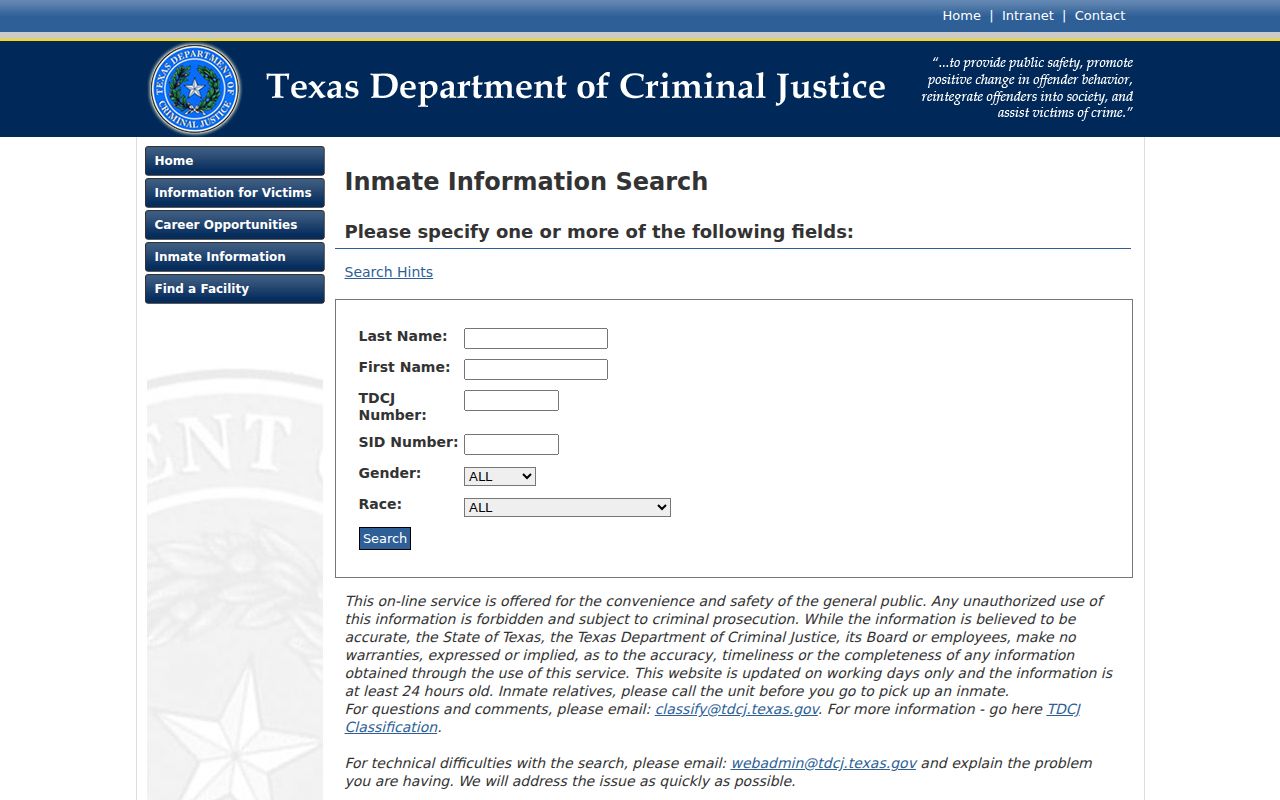
The separate TDCJ interface underscores why registration and present incarceration must be checked through different official systems.
Harrison County Registry Compliance Reports
Suspected Harrison County noncompliance should go to the registrant's local authority or the DPS Sex Offender Registry Unit at 512-424-2800. Provide the public profile details and the factual reason for concern. Avoid speculation. Harrison County law enforcement can compare a report with information that is not public and decide whether any follow-up is warranted.
Chapter 62 makes failure to comply a felony in defined circumstances. That enforcement role belongs to public agencies. A private person should not investigate at a residence, trespass, threaten anyone, or publish protected information. The safe route is a concise report through an official phone or agency channel.
Note: A good-faith report gives officials usable facts and leaves verification, contact, and enforcement to trained personnel.
Using Registry Information Lawfully
Harrison County registry information supports personal, family, and community safety. Read it with care. Verify identity, note the profile's source and update context, and contact an official Harrison County authority when a record seems wrong. Public access does not authorize harassment, threats, intimidation, vigilantism, trespass, or misuse of protected facts.
Community notice is handled through DPS publication, optional notifications, statutory postcards, and local law-enforcement duties. The public role is awareness and accurate reporting. It is not punishment beyond what a court and the law impose.
Misuse can be a crime: Texas Code of Criminal Procedure Chapter 62 governs public registry information. Using that information to threaten, harass, intimidate, trespass, or take vigilante action can be criminal conduct. Report a concern to law enforcement instead of confronting anyone.