
Marshall Criminal History Checks
Begin with the office that created the Marshall record. A Marshall police incident or arrest narrative belongs to Marshall Police Department. A Marshall city citation or fine-only state-law case belongs to Marshall Municipal Court. If Marshall police made a custodial arrest, the Harrison County Main Jail produces the booking record. A prosecutor may later file a Marshall felony with the District Clerk or a Class A or B misdemeanor with the County Clerk.
This Marshall order prevents false conclusions. An empty Marshall Municipal Court result does not rule out a county charge. A county court docket will not contain the full Marshall police narrative. The statewide DPS public name search is a later check for reported public convictions and deferred adjudications, not a replacement for these Marshall sources. For a broader county view, the Harrison County criminal history overview maps the other custodians.
- Identify whether the event began as a Marshall police report, citation, warrant, or custodial arrest.
- Request the incident or arrest report from Marshall Police Department with enough facts to locate it.
- Check Marshall Municipal Court for a fine-only citation, court setting, or wanted-person information.
- For a jail booking or county charge, move to the Harrison County Sheriff and the correct county clerk.
- Use the Texas DPS statewide public product only for the public conviction or deferred-adjudication layer.
Marshall Police Report Request Form
Marshall Police Department provides a dedicated police open-records request form. The Marshall form cites Government Code section 552.221 and asks for requester contact details, a description of the information, a signature, and a date. Marshall staff-processing fields appear on the form as well. The form is a request channel, not a public name database.
A Marshall case number is helpful but not required by the research. Without one, describe the Marshall incident date and time, location, involved parties, and the exact item sought. State whether the request is for an incident report, arrest report, audio, video, or another identified record. Name the preferred delivery format. These facts let MPD locate responsive Marshall material without asking the office to answer a broad question.
The City of Marshall also publishes a general open-records form, but use of either Marshall form is optional. Marshall accepts any legible Texas Public Information Act request. Charges may apply, yet no specific Marshall police fee or turnaround was documented, so confirm cost and delivery timing during submission.
Note: Ask for a named record or file; a TPIA request does not require city staff to research a question or create a new answer.
Records at Marshall Police Department
MPD owns the Marshall incident, offense, and arrest reports created by its officers. Those Marshall files can contain the officer narrative, event date and location, alleged offense, probable-cause facts, property or evidence references, and related identifiers. They are different from jail intake and from the court docket. A Marshall report may also require redaction for victim privacy, juvenile confidentiality, protected identifiers, or an active investigation.
Marshall body-camera material needs a precise request. Give the date, approximate time, Marshall location, and details about an involved person or officer that are sufficient to identify the recording. The city may redact protected portions or seek an Attorney General decision when a TPIA exception may apply. A court clerk cannot substitute for this Marshall MPD channel because the filed case does not automatically absorb all police audio, video, or narrative material.
A Marshall traffic crash can follow another Marshall record route. The investigating agency may hold the report, and Texas DPS Crash Records may provide eligible access under current Transportation Code rules. Confirm eligibility and any current fee with that official channel rather than assuming every Marshall MPD event is freely downloadable.
Marshall Warrant Records by Name
The Marshall Municipal Court page explains its docket services, provides hearing-request information, and links a wanted-person channel. That source concerns municipal matters, including city ordinances, citations, and fine-only state-law offenses. It is not the Harrison County felony index.
If a Marshall warrant page shows a name, first confirm the spelling, Marshall court, case or warrant number, and charge. Then contact the issuing Marshall court for current status and instructions. Ask how to request a setting or resolve the matter and how to obtain written proof after payment, recall, or other action. Marshall online lists may not update at once. Do not assume the name still reflects an active warrant.
A Marshall district, county, justice, or municipal court can issue a warrant within its own case. Sealed Marshall warrants and law-enforcement-only TCIC details are not public. Someone addressing their own Marshall warrant should call the issuing court or qualified counsel before appearing and should not use a tip line to ask about themselves.
Booking and Arrest Records in Marshall
A custodial Marshall arrest creates records in more than one place. MPD creates its report. Harrison County Main Jail at 110 South Franklin Street creates booking, fingerprint, photograph, charge, bond, custody, and release entries. The jail is the main intake and processing facility for men and women. The Travis Street Annex serves as male-only overflow, but published county material does not provide unit capacities.
For a recent Marshall booking, follow the official inmate-search link from the Harrison County Sheriff page. If the linked search fails or time matters, jail administration can address urgent Marshall custody questions at 903-923-4003. Absence from a current roster is not proof no Marshall arrest happened. The person may have bonded, been cited, been released, or moved to another facility.
A Marshall arrest charge is an intake allegation. Prosecutors decide what Marshall charge to file, and the filed charge can differ. The full Harrison County arrest search process covers the county roster, Marshall report requests, and court follow-up without turning a booking entry into proof of guilt.
Note: A Marshall booking states the intake allegation and custody facts, not the final filed charge or a finding of guilt.
Marshall Custody Records After Booking
Marshall custody can move from the county jail to a state facility after sentence. The TDCJ offender-information channels offer online, email, and telephone routes for state prisoners. They do not contain MPD reports or all Harrison County jail bookings.
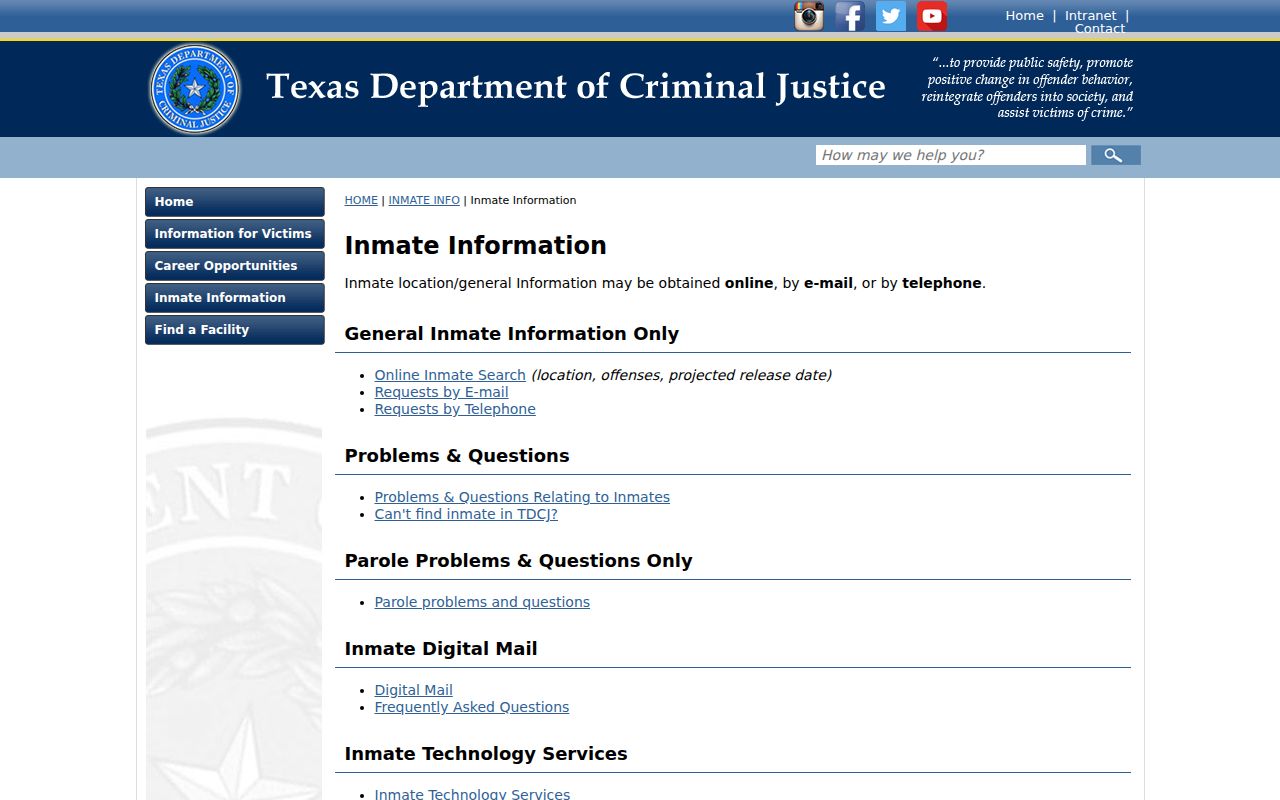
The state information page shows why a Marshall record check may need a separate custody search after the county stage ends.
TDCJ search fields can include a Marshall name, TDCJ number, or state identification number, with results such as facility, offense, and projected release information. Use the Marshall court judgment to determine the sentence and TDCJ to check current state custody. For a federal sentence, the Bureau of Prisons locator is the custody source. Each Marshall database answers a different question.
The Marshall Municipal Court File
Marshall Municipal Court hears city ordinance matters and fine-only state-law or citation cases. It provides hearing requests, docket information, and the wanted-person route. It does not keep adult felony files or Harrison County Class A and B misdemeanor files. Those belong to the District Clerk and County Clerk, respectively.
A Marshall municipal record can document the citation, court settings, plea, judgment, fine, costs, and warrant or capias information where public. Ask the Marshall court which documents are available and whether a copy charge applies. The research found no verified Marshall municipal fee schedule, so no amount should be assumed.
| Court Name | Marshall Municipal Court |
|---|---|
| Case Types Heard | City ordinances, Class C or other fine-only state-law offenses, and citations |
| Lookup Channel | Official court page, wanted-person channel, hearing request, and direct court contact |
| File Contents | Citation, settings, plea, judgment, fine, costs, and public warrant information as applicable |
| Copies & Fees | Ask the court for current availability and cost; no local schedule was verified |
Note: Search Marshall Municipal Court for fine-only city matters, then use the county clerk that matches any higher-level filed charge.
Marshall Citation and Charge Records
Offense level determines where the record goes. A citation-only Marshall matter can remain in Municipal Court. A Class A or B misdemeanor proceeds through Harrison County Court at Law, where the County Clerk maintains the file. An adult felony proceeds in the 71st District Court, with the District Clerk as custodian. Checking only one court can therefore produce an incomplete result.
The county clerks need enough Marshall identifying information to search. For a Marshall felony, give the District Clerk a case number when known or the defendant's full name and a useful date range. Ask for the Marshall indictment, docket, judgment, bond order, and certified copies that matter to the question. For a Marshall Class A or B misdemeanor, the County Clerk can be reached at 903-935-8403 or CCMisdemeanor@harrisoncountytexas.gov.
Common court terms have distinct meanings. A disposition is the outcome. A dismissal ends a filed charge without a conviction on that charge. An acquittal is a not-guilty result after adjudication. Deferred adjudication is supervision without an immediate judgment of guilt, and it may remain public in Texas unless a nondisclosure order applies.
How Marshall Records Reach the County
The Marshall path begins with the city agency but may end in several systems. Marshall MPD supplies the incident and arrest report. A Marshall custodial arrest goes to the county jail. A prosecutor selects the proper court. The clerk then maintains the filed Marshall case and reports disposition information through Texas criminal-history channels. Delays, missing fingerprints, name variations, and late disposition reports can make two systems disagree.
Record flow: Marshall Police Department › Harrison County Jail and Courts › Texas Department of Public Safety. Parole adds another state layer. The official TDCJ district-office mapping assigns Harrison County to the Marshall District Parole Office.
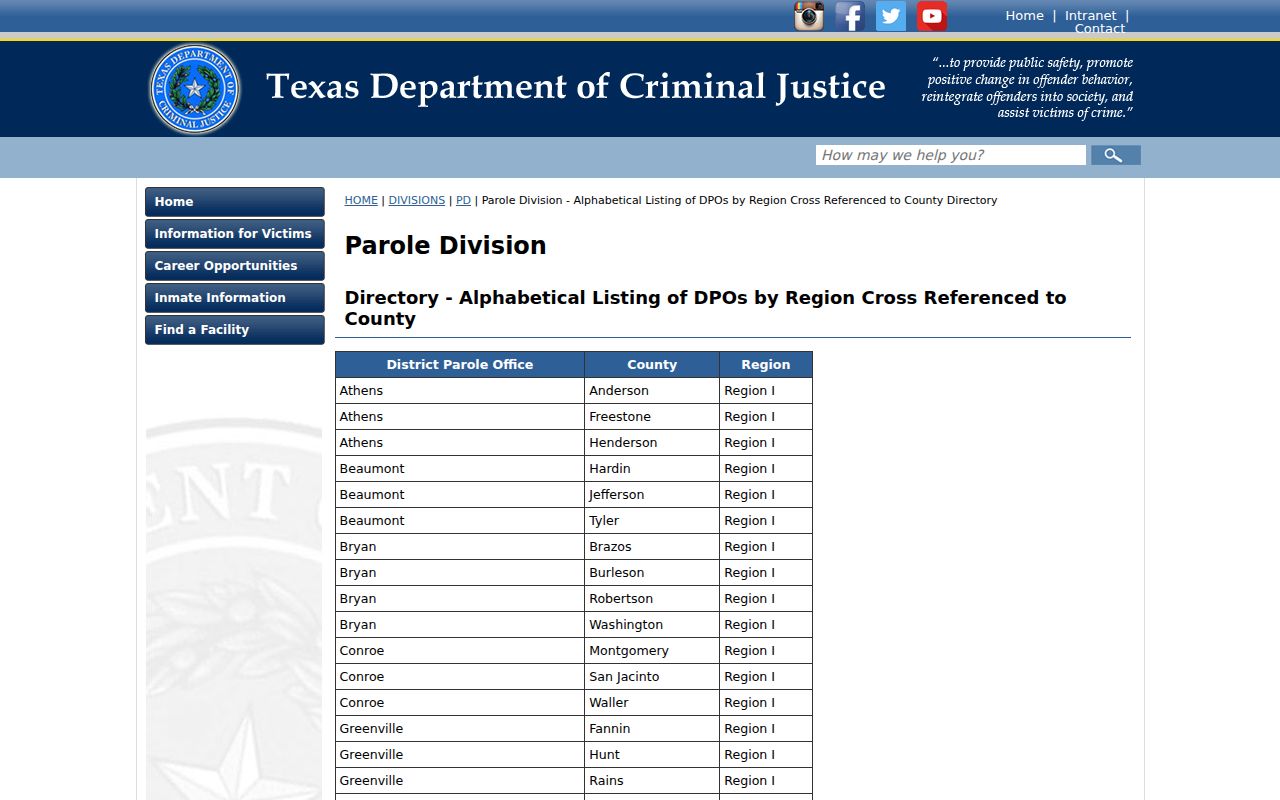
The mapping confirms which field office serves a Marshall parole question after a state prison release.
Recent city facts belong with MPD or the jail. Filed charges and outcomes belong with the clerk. DPS is the statewide public conviction and deferred-adjudication layer. A complete Marshall record check may need each source in that order.
Marshall Criminal Records by Population
Marshall is Harrison County's seat and largest incorporated city. The U.S. Census Bureau estimated 24,467 residents on July 1, 2025, compared with 23,392 people in the 2020 Census. The city covers 29.59 square miles. Those figures help explain why Marshall has its own police-report channel and municipal docket while also serving as the physical center of many county justice offices.
The justice trail is compact but not unified. The working Harrison County Courthouse, Sheriff's Office, and Main Jail cluster around West Houston and South Franklin streets. The Historic Courthouse at 1 Peter Whetstone Square is a different building. A requester seeking a felony file should use the working courthouse and District Clerk, not assume that the prominent historic structure is the criminal-record counter.
Location does not merge custodians. MPD still owns its narratives. Municipal Court keeps city cases. County clerks keep filed county charges. The Sheriff keeps booking records. This division reflects record function, even when the offices sit only blocks apart.
Note: The historic courthouse is a Marshall landmark, but the working courthouse is the starting point for current county criminal files.
Marshall Parole and Supervision Records
Marshall also hosts the district parole office at 2304 East Travis Street. The office serves Harrison, Marion, Panola, and Shelby counties and lists 903-938-1277 as its phone. It is separate from Harrison County Adult Probation, which supervises court-ordered community supervision and can be reached at 903-923-4016. The TDCJ Region I parole directory identifies the Marshall office in the state field structure.
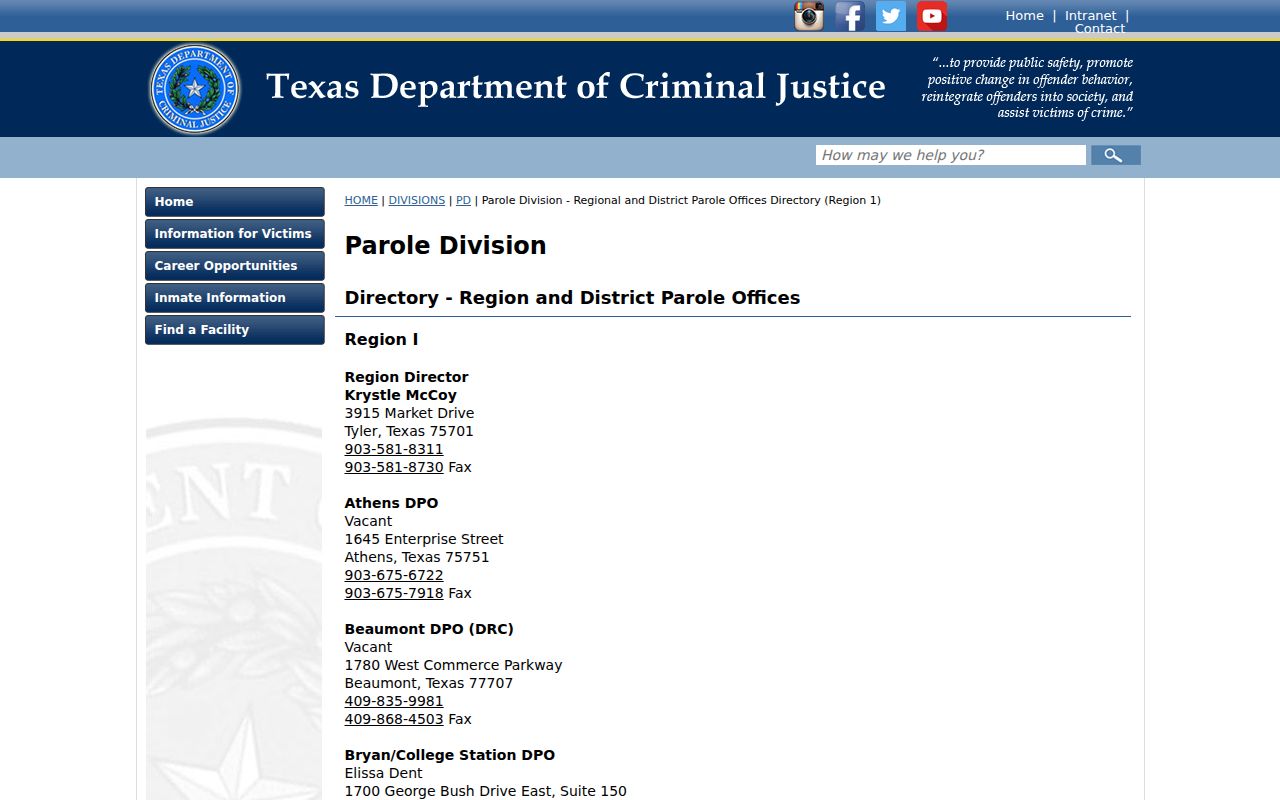
That office listing is the right local route for field-supervision questions, while a court judgment remains the best public proof of a probation sentence.
Parole review is a separate function from field supervision. The Texas Board of Pardons and Paroles ombudsman information explains review-status channels and agency roles.
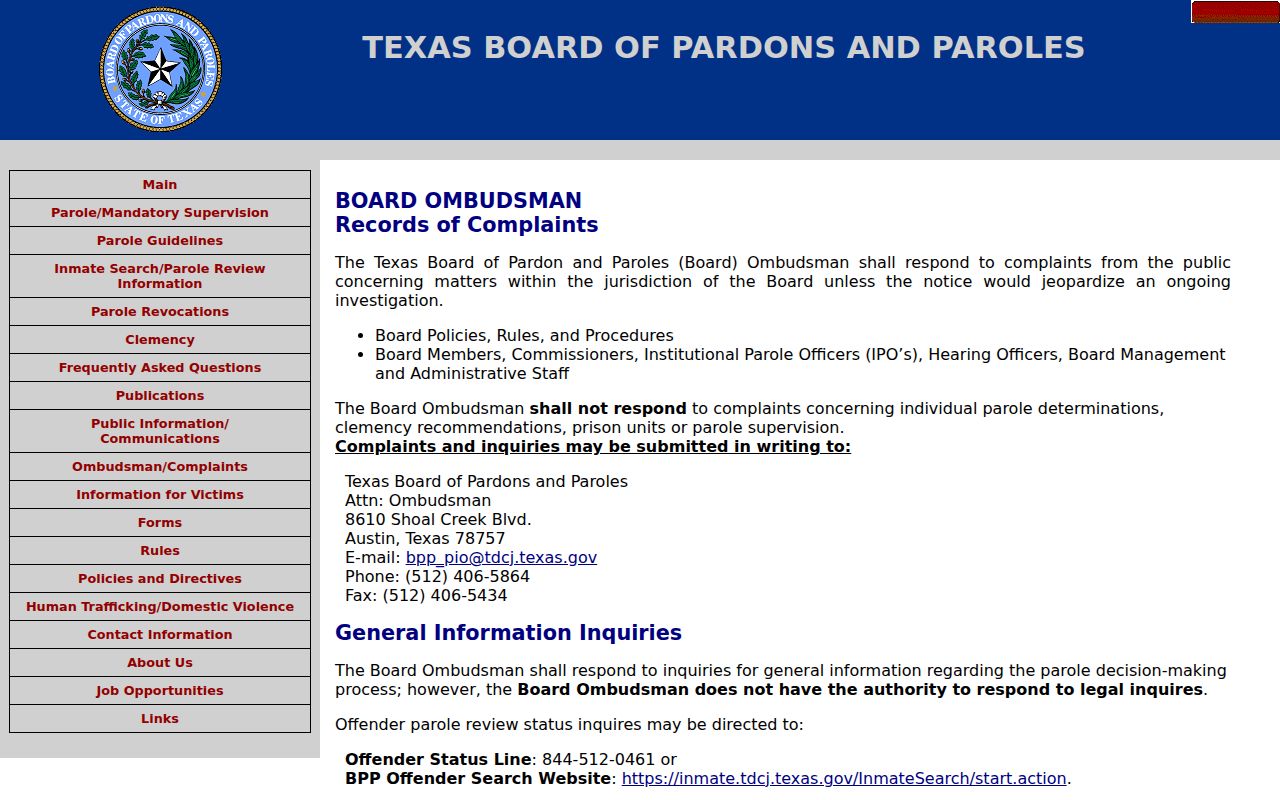
The distinction helps keep a Marshall DPO contact from being mistaken for the board channel that tracks a parole decision.
Marshall Record Access Rules
The Texas Public Information Act governs requests to Marshall and other local agencies. A requester should describe existing records, and the city must act under the law's prompt-production and Attorney General decision procedures. Release can still involve redaction, a cost estimate, or a ruling request when a statutory exception may apply.
Criminal-history dissemination rules are narrower than ordinary document access. Public DPS output covers specified reported convictions and deferred adjudications. It does not reproduce every MPD narrative, juvenile file, sealed item, or local docket. Federal cases sit outside both city and county courts. The official PACER service is the registered federal case-record channel.
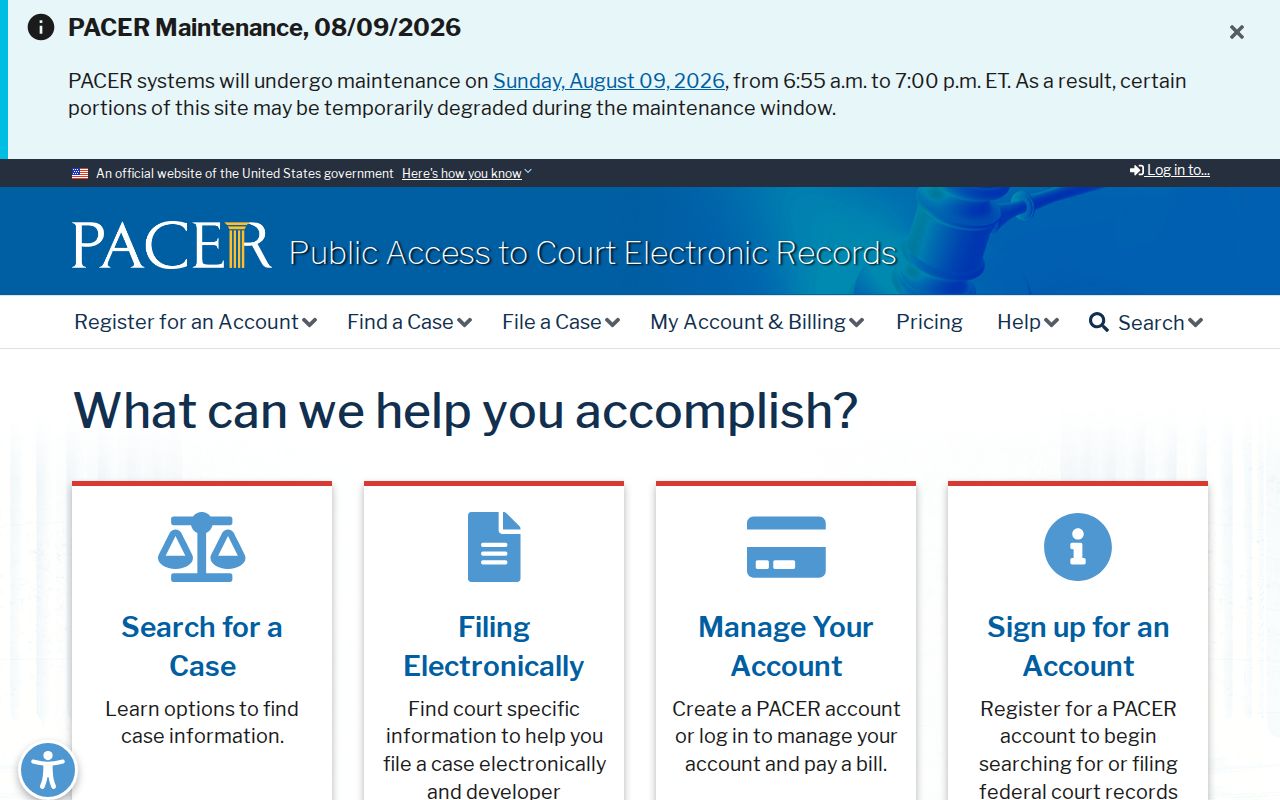
The PACER interface marks the separate federal layer and should not be used as a substitute for Marshall Municipal Court or Harrison County clerks.
Key statutes:
Texas Government Code Chapter 552 establishes public access, prompt production, and the Attorney General ruling process.
Texas Government Code Chapter 411 controls criminal-history dissemination and public access to specified conviction and deferred information.
Texas Code of Criminal Procedure Chapter 62 controls public sex offender information and protects specified identifiers and victim data.
Note: Public access can reveal a record, but it does not make every allegation accurate, current, or proof of guilt.