
Harrison County Criminal History Checks
Begin with the event, not a broad name search. A recent arrest belongs first with the Harrison County Sheriff and Main Jail. An officer's report remains with the arresting agency. Adult felony filings go to the District Clerk, while Class A and B misdemeanor files go to the County Clerk. Fine-only citations may stay with a municipal or justice court. This split is central to any sound Harrison County criminal records search. One office does not hold the whole history.
Gather a full legal name, date of birth, spelling variants, approximate event date, and location. A case or booking number makes the search far more precise. Name-only matches require care, since two people may share the same identifiers. When a result matters, compare the court, charge, dates, and disposition before treating it as the right person. Ask the record holder for a certified copy when proof of an official outcome is needed.
- Choose the record slice: police report, booking, filed case, statewide history, custody, warrant, or registry listing.
- Start at the agency that created that record and use the strongest identifier available.
- Read the result for court, date, charge level, and status before deciding it is a match.
- Move from the index to the source document, such as the judgment, booking entry, or incident report.
- Request certification or a fingerprint self-review when identity and final outcome must be clear.
For Harrison County criminal court details, the court case lookup explains how the felony and misdemeanor routes differ. A docket index is useful, but the judgment states what the court ordered.
Six Harrison Criminal Record Keepers
Harrison County criminal history is a chain of records. The arresting agency writes the incident narrative. The Main Jail records intake, fingerprints, photo, charges, bond, and release. The prosecutor decides what charge to file. The correct clerk then maintains the case. DPS connects reported arrest and disposition data at the state level. Municipal courts retain city citation matters that may never enter a felony search.
The county's official department directory is the safe starting point when a portal link changes. The official page is also important because online searches for “Harrison County inmate” can lead to a same-name county in Mississippi. Follow the Texas county domain rather than a lookalike result.
| Record needed | Harrison County source | Best fallback |
|---|---|---|
| Incident or arrest narrative | Sheriff or arresting city police | Written TPIA request |
| Booking and current custody | Main Jail and sheriff search link | Jail administration phone |
| Adult felony case | District Clerk | Counter or records request |
| Class A or B misdemeanor | County Clerk | Dedicated misdemeanor email |
| Fine-only city citation | Municipal or justice court | Issuing city court |
| Public statewide history | Texas DPS Crime Records Division | Fingerprint self-review |
The county homepage illustrates this department-based structure. View the official Harrison County source for its current directory.

The directory helps route a request to the office that created or preserves the specific record.
The county's official officeholder list confirms the elected Harrison County offices responsible for key local records.
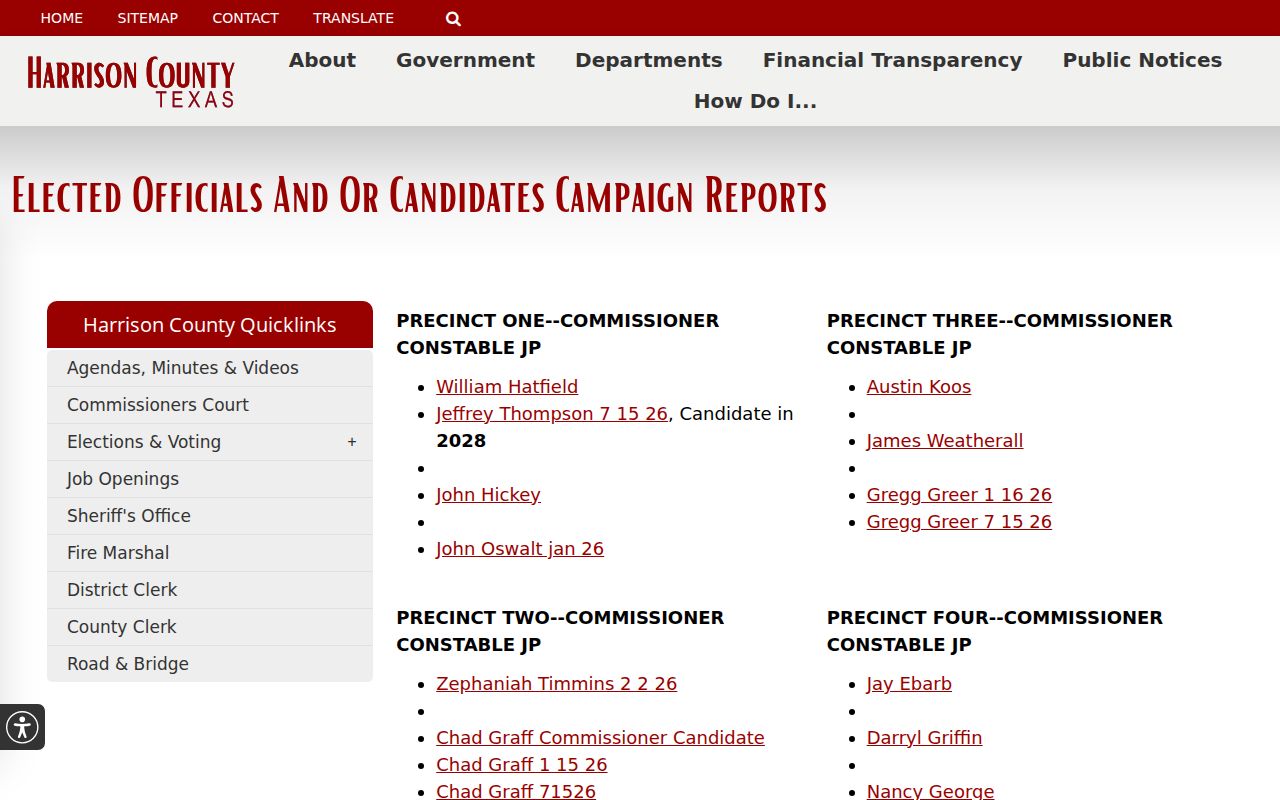
The officeholder source helps distinguish the current sheriff's role from the separate clerk and court custodians.
Official Background Checks in Texas
The Texas Department of Public Safety Crime Records Division maintains the central criminal-history repository. Its public Criminal History Conviction Name Search requires an account and prepaid credits. The output is limited to public convictions and deferred adjudications reported to DPS. It is not a police-report archive, a live booking log, or a copy of every Harrison County docket. Each name search uses one $1 credit. Credit-card orders add 2.25 percent plus $0.25 per transaction.
For a review of your own Texas history, fingerprints are the stronger identifier. FAST appointments are scheduled through IdentoGO. DPS lists a $15 record fee plus a $10 electronic fingerprint fee, and two hard fingerprint cards cost $20. The scheduler reveals sites only after the correct service code or reason is entered, so no unverified Marshall enrollment address should be assumed. DPS says results may take about ten business days after receipt, plus mail time.
| Official product | Published cost | Scope |
|---|---|---|
| DPS public name search | $1 credit plus card charges | Public reported convictions and deferred adjudications |
| DPS offline name check | $10 | Public name-based result |
| FAST fingerprint review | $15 plus $10 electronic print fee | Your fingerprint-matched Texas history |
| Two hard fingerprint cards | $20 | Cards only, not the resulting record |
The official DPS fee and identity FAQ explains the cost and accuracy difference between name and fingerprint checks.
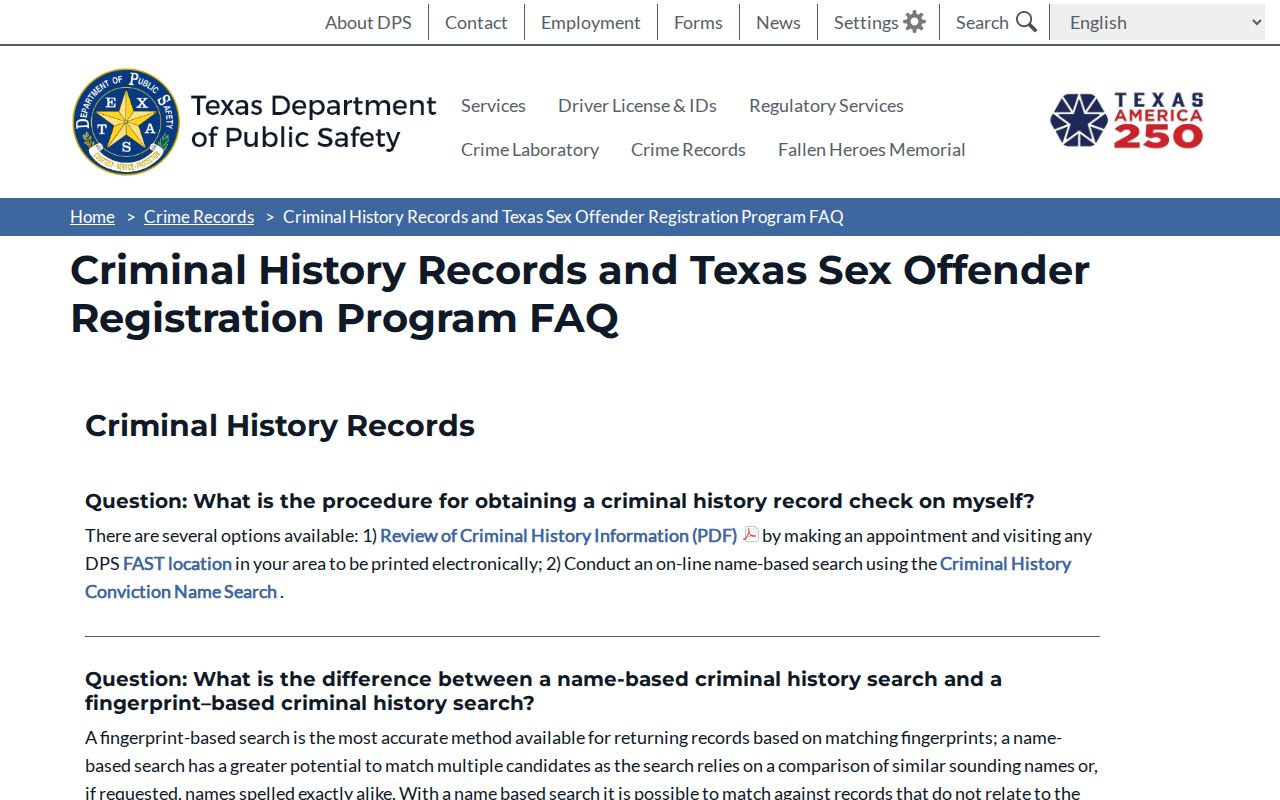
The fingerprint route is the sound choice for a personal record review because it ties the result to the subject's prints.
The DPS public conviction-search instructions set out the account, credit, and matching limits before a user submits a name.

Those limits show why a paid public name result should still be checked against the original Harrison County record.
Harrison County DPS Search Results
The Texas Criminal History Conviction Name Search asks the user to decide whether a result belongs to the intended person. Enter a full last name and first name, then use date of birth and sex to narrow the match. Similar-sounding and exact-name behavior can change what appears. One credit is consumed for the search, so review the entries before submitting.
A Harrison County arrest may be absent because DPS has not received a complete fingerprint-supported cycle, the court disposition is late, or the public law does not permit that event to be shown. The opposite problem also occurs: a common name may return someone else. The county judgment and a fingerprint self-review are the better tools for resolving doubt.
| Search control | Use | Identity note |
|---|---|---|
| Account sign-in | Required to search | Create the public CRD account first |
| Last and first name | Primary fields | Test legal spelling and known variants with care |
| Date of birth | Narrows results | Exact date strengthens a name match |
| Sex selection | Optional narrowing | Female, Male, or Either may be available |
| Search credit | Consumed on submission | One credit per search |
The official search screen shows the statewide tool without exposing a private record. See the DPS portal source before using a credit.
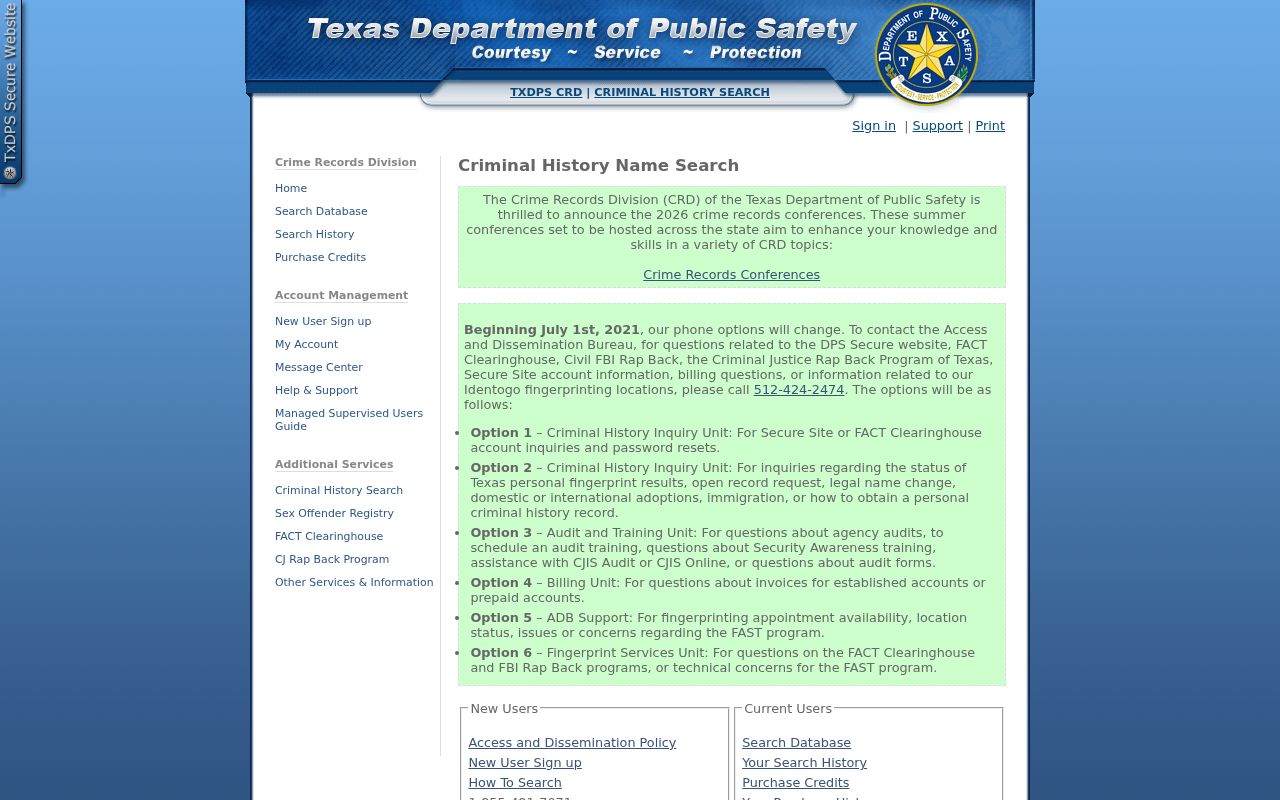
The sign-in requirement and state scope show why this product differs from a free local jail lookup.
Kinds of Criminal Records
An arrest report records what an officer alleged and observed. A booking file is the jail's custody snapshot. A charging instrument is the accusation filed by a prosecutor or returned by a grand jury. The court docket then tracks settings, motions, pleas, and orders. These are related Harrison County criminal records, but they do not answer the same question.
Custody and supervision records also split. The Harrison County jail covers local custody. The Texas Department of Criminal Justice locator covers sentenced state prisoners. County CSCD supervises community supervision, while the TDCJ Parole Division handles parole. The Texas Public Sex Offender Registry is a separate public-notification system. A warrant originates with a court, even though law enforcement executes it.
- Arrest and booking records: allegations, intake, bond, facility, and release status.
- Criminal court files: filed counts, docket events, judgment, and sentence.
- DPS history: fingerprint-linked cycles with public output set by Texas law.
- Warrants: court orders whose public status may require direct confirmation.
- Supervision and registry records: probation, parole, and public registration details kept by separate authorities.
Do not read an intake charge as a final conviction. The prosecutor may file a different offense, and the court may dismiss, acquit, defer, or convict.
Harrison County Booking Records Differ
The Main Jail at 110 South Franklin Street is the primary intake and processing site for men and women. The Travis Street Annex provides overflow housing for men. The sheriff's official page links both “Court & Jail Records Search” and “Harrison County Inmate Search.” If the public link fails, call jail administration at 903-923-4003 for an urgent custody question or submit a written request for releasable jail material.
A booking entry may show an intake time, booking number, arresting agency, initial charge, bond, facility, and release status. It does not state the final court result. Someone who bonded out, received a citation, transferred, or was released may no longer appear in a current roster. Follow the event to the correct clerk after charges are filed. The dedicated Harrison County arrest search covers the complete agency and custody route.
Identity caution: Absence from the live roster does not prove that no arrest occurred, and a same-name booking does not prove identity.
Harrison County Criminal Records: What They Contain
A full criminal-history cycle begins with identity and arrest data, then gains court and sentence information as agencies report it. Public versions remove or withhold protected details. Read each field in context. “Disposition” means the case outcome, such as dismissal, acquittal, conviction, or deferred adjudication. Deferred adjudication is community supervision without an immediate judgment of guilt, but it remains public in Texas unless a nondisclosure order applies.
| Name & Identifiers | Legal name, aliases, date of birth, sex or race, state ID, and possibly an FBI number. |
|---|---|
| Arrest / Booking Data | Arrest date, agency, charge, booking number, bond, facility, and release status. |
| Charges & Statutes | Offense label, law citation, degree or class, count, and filed instrument. |
| Disposition | Conviction, dismissal, acquittal, no-bill, or deferred adjudication with its date. |
| Sentence | Confinement, fine, costs, restitution, or community-supervision term. |
| Custody / Supervision Status | County jail, TDCJ custody, release, probation, or parole data where public and reported. |
Public records should not expose Social Security numbers, protected driver-license data, victim identity, juvenile material, or sealed and expunged content. If a docket abbreviation is unclear, request the filed order rather than guessing from a short event code.
Empty Harrison Criminal Record Results
An empty portal result is a routing clue, not a final answer. First confirm that the county is Harrison County, Texas. Then check whether the event belongs to a city court, the County Clerk, or the District Clerk. A fine-only Marshall citation may not appear in the felony system. A recent booking may have ended before the live roster was checked. Older paper files may require archive retrieval.
For a felony search, give the District Clerk the full name, approximate year, offense, and court if known. For a Class A or B misdemeanor, contact the County Clerk at 903-935-8403 or CCMisdemeanor@harrisoncountytexas.gov. The sheriff's open-records role is identified under Lieutenant Cindy Black. A request should describe a record, not ask the office to research or answer a question.
District Clerk
200 W. Houston St., Suite 234
Marshall, TX 75670
903-935-8409
Adult felony records
County Clerk
200 W. Houston St.
Marshall, TX 75670
903-935-8403
Class A and B misdemeanors
Main Jail
110 S. Franklin St.
Marshall, TX 75670
903-923-4003
Urgent custody questions
Call before travel if counter access, copy fees, or archive timing matters. The working courthouse is at 200 W. Houston, not the Historic Courthouse at Peter Whetstone Square.
The official Harrison County contact directory publishes the working courthouse address, weekday hours, and department numbers.
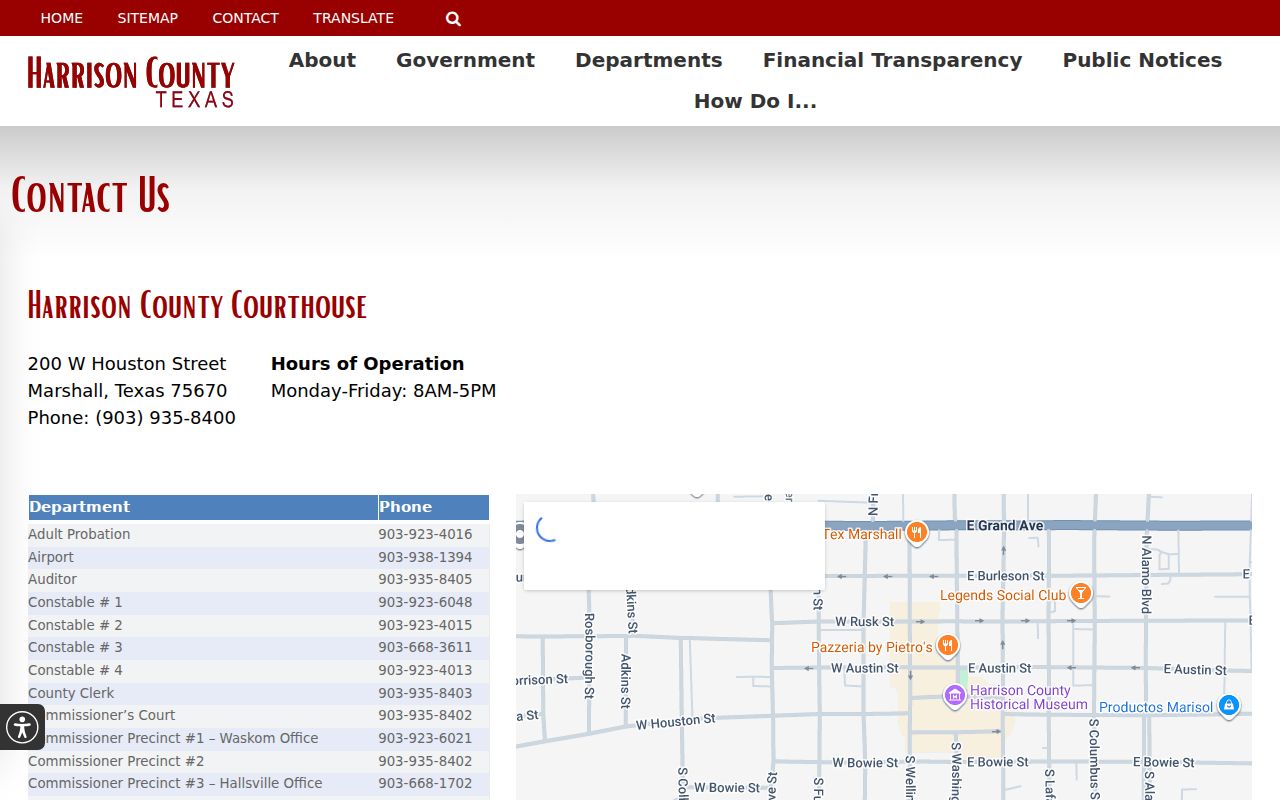
The directory is the best place to confirm the correct counter before traveling to Marshall for a file.
Texas Public Access Laws
The Texas Public Information Act makes public information available through the office that holds it, subject to exceptions. Government Code section 552.221 calls for prompt production. If the material cannot be produced within ten business days, the office must certify a reasonable date and time when it will be available. That period is not a universal deadline for delivery. Ten business days is also important when an agency seeks an Attorney General decision under section 552.301.
Key Texas laws:
Government Code Chapter 552 governs public requests, prompt production, and exception procedures.
Government Code Chapter 411 limits criminal-history dissemination and authorizes specified public conviction data.
Code of Criminal Procedure Chapter 66 establishes reporting from criminal-justice agencies and courts to DPS.
Code of Criminal Procedure Chapter 55 controls expunction eligibility, petitions, and effect.
Code of Criminal Procedure Chapter 62 governs sex-offender registration and public registry data.
Protected personal identifiers, juvenile files, sensitive victim information, and active-investigation material may be redacted or withheld. Include the incident number, date, location, agency, exact document or media, and preferred delivery format to help the office locate responsive records.
Harrison County Custody Record Systems
Three custody searches cover different places. The Harrison County jail link reflects local detention and booking. The Texas Department of Criminal Justice Online Inmate Search covers people in state custody and may show offenses, location, and projected release data. The federal Bureau of Prisons locator covers federal sentenced prisoners. Harrison County lies in the Eastern District of Texas, but a federal docket remains separate from county clerk systems.
Use the local jail first for a fresh Harrison County arrest. If the person was sentenced and transferred, move to TDCJ. Use the BOP locator only for federal custody. None of these locators replaces the judgment or full case file. Custody can change faster than a separate docket or state-history system updates.
Note: City Telecoin, JailATM, and Commissary Express serve calls, deposits, and commissary needs; they are not criminal-record databases.
Restricted, Sealed & Expunged Records
Texas uses “expunction” for a process that can order eligible records destroyed or returned. Chapter 55 covers defined outcomes, including some acquittals, pardons, dismissals or no-bills after statutory conditions, and mistaken-identity cases. A dismissal by itself does not guarantee eligibility. A petition must identify the arrest, charge, case, court, outcome, and each agency that holds the record so notice and the final order reach the right custodians.
An order of nondisclosure has a different effect. It restricts public release of an eligible history but leaves the record available to entities listed by law. Deferred adjudication is often part of the path, yet waiting periods and offense exclusions vary. Juvenile justice material is generally restricted under Texas Family Code Chapter 58 and should not appear in an ordinary adult public portal.
- Expunction
- Eligible records are destroyed or returned under a court order.
- Nondisclosure
- Public disclosure is limited, but authorized access continues.
- No-bill
- A grand jury declines to return an indictment.
- Acquittal
- A not-guilty outcome after adjudication.
Start with the Harrison County District Clerk for current local filing requirements, service lists, hearing practice, and fees. After an order, obtain certified copies, check local portals, and review your DPS fingerprint record. Each system needs time to process the change.
Texas Code of Criminal Procedure Chapter 55 contains the controlling expunction provisions. A fingerprint self-review begins through the official FAST scheduling source.
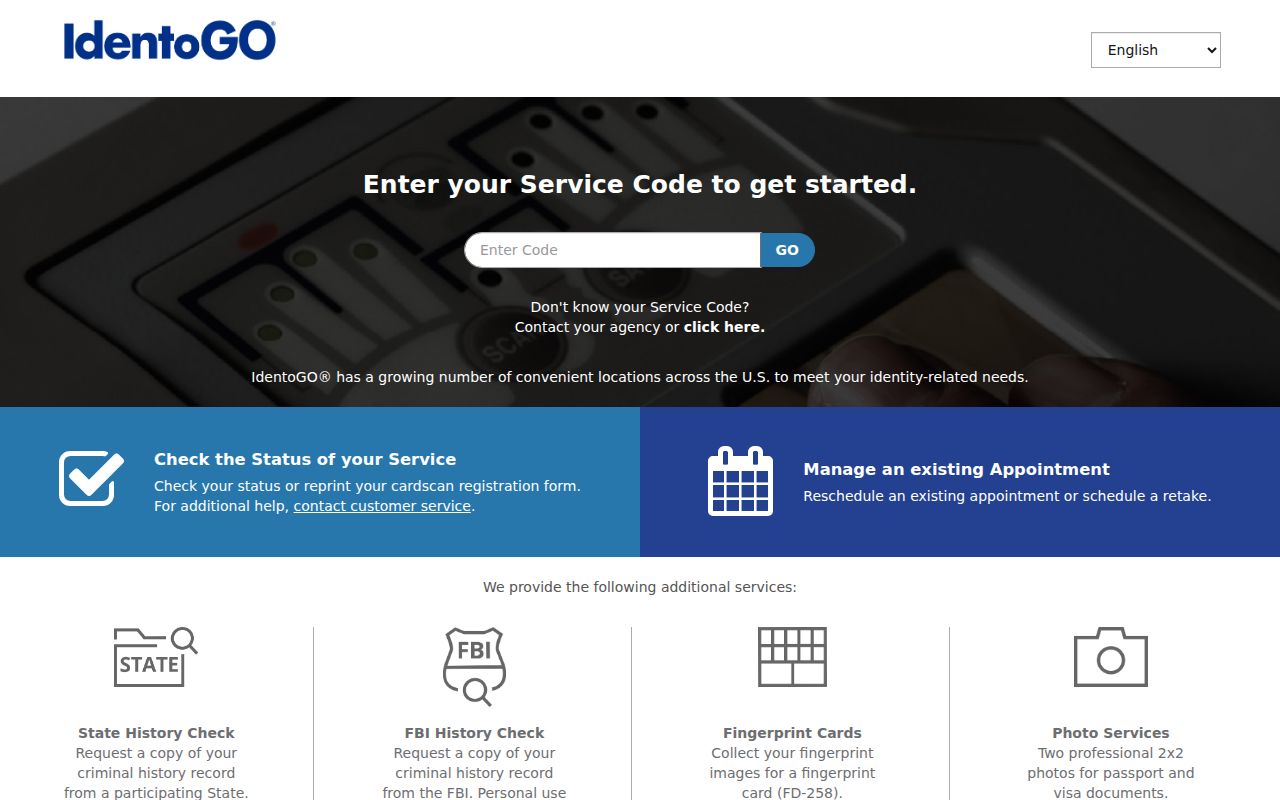
The FAST scheduling route supports the final self-review used to check whether an ordered change reached the state history.
Harrison County Supervision Records Split
Community supervision and parole are not the same. Harrison County Adult Probation and the Community Supervision and Corrections Department supervise court-ordered probation and deferred adjudication. The court judgment is the best public proof of the sentence, and the CSCD direct phone is 903-923-4016. Detailed officer notes and supervision conditions should not be assumed public.
Parole follows state prison custody and is supervised through the TDCJ Parole Division. The Marshall District Parole Office is at 2304 East Travis Street, Marshall, with phone 903-938-1277. It serves Harrison, Marion, Panola, and Shelby counties. The Texas Board of Pardons and Paroles handles parole decisions, while the field office handles supervision. A TDCJ locator entry and the court file answer different parts of the history.
When a violation is filed, the public trail may include a motion to revoke or adjudicate, a capias or warrant, a hearing, and an order that continues, changes, or revokes supervision. “Capias” means a court writ directing arrest after a procedural trigger.
The Texas Crime Records Division explains how these agency reports feed statewide systems. Review the official DPS services source for the current program structure.
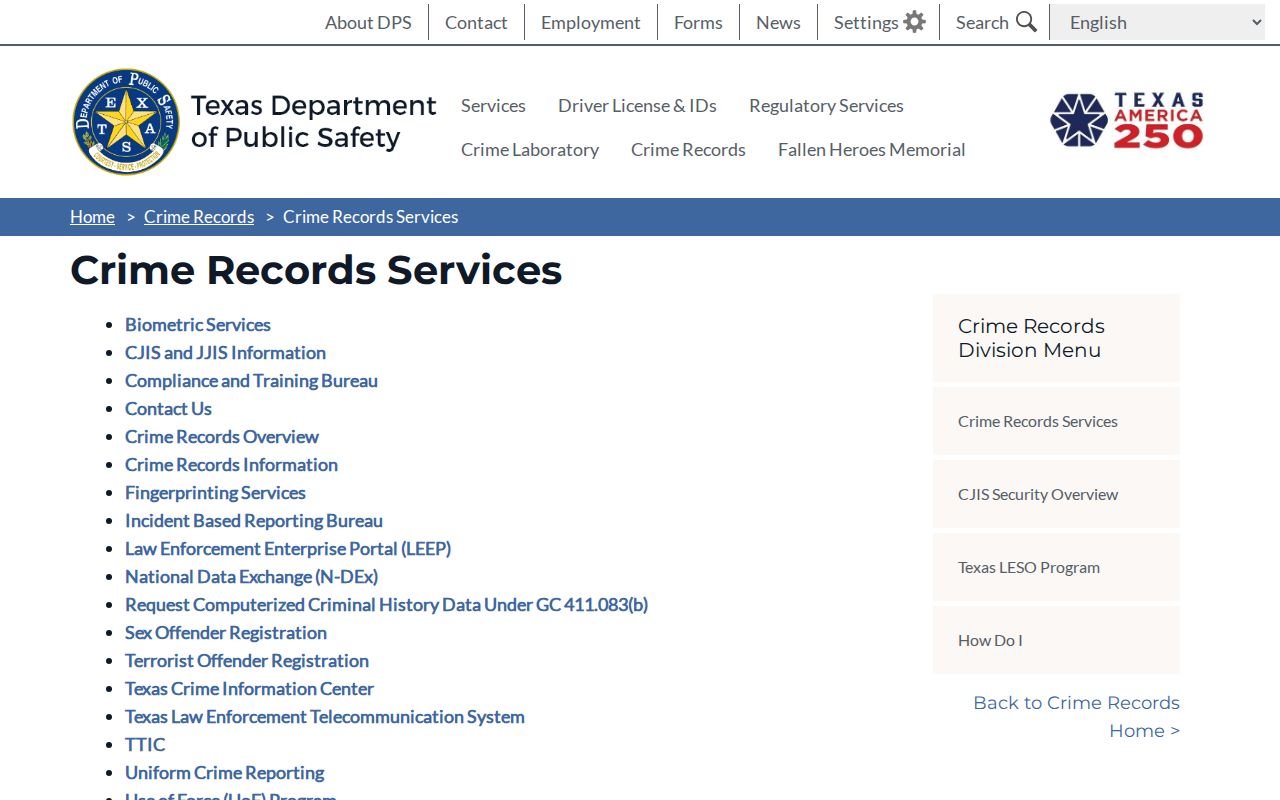
The state service map reinforces why a local court order and the DPS history must sometimes be checked together.
City-by-City Criminal Records in Harrison County
Marshall, Hallsville, and Waskom each keep city-level police and municipal court records. A city police report stays with that police agency. Fine-only citations can remain in the municipal court, while a custodial booking moves to the Harrison County Main Jail. Filed Class A or B misdemeanors and felonies later route to the correct county clerk. Start with the city that issued the citation or made the arrest, then follow the offense level.
Marshall Record Check
County seat · MPD reports, Municipal Court citations, and a wanted-person channel
Hallsville Record Check
Hallsville PD reports · Municipal Court handles Hallsville police citations
Waskom Record Check
I-20 border city · City records, municipal citations, and county booking routes
Marshall has a dedicated police open-records form and municipal wanted-person channel. Hallsville's official court page expressly covers Hallsville Police Department citations. Waskom has no verified public arrest blotter or police app, so the official city, police, and municipal court contacts are the proper fallback.
Correct Harrison County Criminal Records
A missing disposition can leave a statewide history looking incomplete. Compare the DPS entry with the source court's judgment. If the court file shows a dismissal or other outcome that DPS lacks, obtain a certified copy from the District Clerk or County Clerk. Then use the Crime Records Division Criminal History Inquiry and Data Integrity channels. The Access and Dissemination Bureau phone is 512-424-2474.
Mail for the Criminal History Inquiry Unit goes to P.O. Box 4143, Austin, TX 78765-4143. Keep copies of the disputed entry, certified outcome, and any expunction or nondisclosure order. Correcting a source error differs from clearing an otherwise accurate record. The first task fixes reporting. The second requires eligibility and a court order under the proper Texas remedy.
A fingerprint review is safer than repeating a name search after a correction. The official FAST scheduler requires the right service selection before it displays a site, which prevents an unsupported local address from being published.